

Global Automobile Market: Trends, Growth, and Outlook for 2026
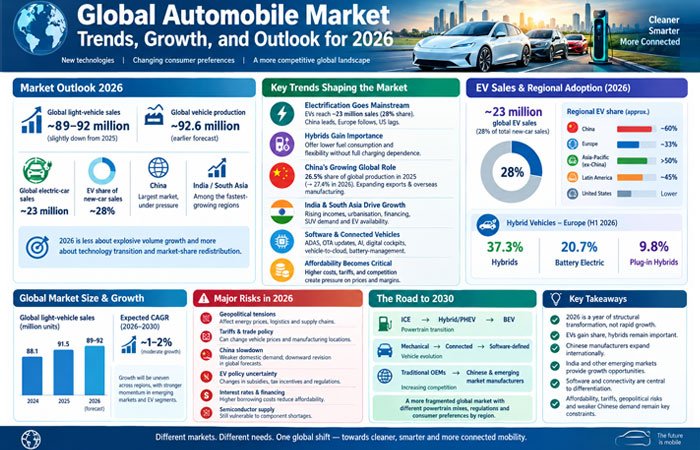
The automobile industry has entered a strange kind of equilibrium in 2026. After years of pandemic disruption, chip shortages, and an electric-vehicle boom that promised to remake the industry overnight, this year looks more like a market catching its breath flat in volume, but anything but flat in structure. Market research firm 6Wresearch has been tracking this shift closely in its coverage of the global automobile market, and the numbers point to a balance of power between regions, technologies, and manufacturers that is changing faster than headline sales figures suggest.
A Market Holding Its Size, Not Its Shape
Global light-vehicle sales are on track to land close to 90–92 million units in 2026, essentially flat compared with recent years. Estimates of the market’s overall dollar value vary widely depending on methodology and what’s included vehicle manufacturing, retail sales, parts, and services are often measured separately but the direction is consistent across sources: modest single-digit growth is expected through the early 2030s rather than the double-digit expansion seen in the previous decade.
That headline stability is deceptive. It masks weak demand in mature markets like the US and Europe, where new vehicle prices have climbed 15–25% since 2020, squeezing affordability and pushing buyers to hold onto older cars for longer. Meanwhile, growth is increasingly concentrated in Asia-Pacific, which is projected to expand faster than any other region over the next decade, driven by rising incomes, urbanization, and domestic manufacturing capacity.
Electrification: Real, But No Longer a Straight Line
The electric vehicle story has matured from breathless hype into something more complicated. Global EV sales are expected to reach roughly 23 million units in 2026, close to 30% of all auto sales worldwide, a genuinely enormous share for a technology that barely existed at scale a decade ago. But growth has become uneven, and in some Western markets it has stalled outright as government purchase incentives expire and high prices deter buyers.
Hybrids have been the quiet beneficiary of this hesitation. As full battery-electric adoption plateaus in North America and parts of Europe, hybrids are absorbing demand from buyers who want lower emissions without range anxiety or charging-infrastructure headaches. For automakers, this has forced a strategic pivot: many are now building flexible factories capable of producing gasoline, hybrid, and electric vehicles side by side, hedging against further policy or demand swings rather than betting everything on one powertrain.
China’s Export Machine
If there is one storyline defining the 2026 auto market, it’s China’s transformation from the world’s largest domestic car market into its most aggressive exporter. China now produces close to 30% of all vehicles made worldwide and manufactures roughly three-quarters of the world’s EVs. Facing brutal domestic price competition sometimes called “involution,” a form of destructive competition that erodes margins without growing the overall market Chinese manufacturers have turned outward.
The numbers are striking. Chinese new-energy-vehicle exports have been setting records nearly every month, with shipments up well over 100% year-on-year at points in 2026, and exports now account for roughly a third of China’s total NEV wholesale sales, up from about a fifth a year earlier. Rather than simply shipping finished cars abroad, firms including BYD, Geely, Chery, Great Wall Motor, and SAIC now operate dozens of factories overseas from Hungary to Southeast Asia to South America embedding themselves directly into local markets instead of exporting into them from a distance.
This expansion hasn’t gone unchallenged. The EU has imposed countervailing duties as high as 35% on Chinese EVs, Mexico plans to raise tariffs on Chinese vehicles significantly starting in 2026, and Brazil, India, and several Southeast Asian countries have tightened or reinstated import duties that previously fuelled Chinese export growth. Beijing itself has added a layer of control, requiring EV manufacturers to obtain export permits from 2026 onward a move framed as fostering “healthy development” of the industry, but one that also gives the government more direct oversight of a sector central to its global trade ambitions.
Competitive Reordering at the Top
The corporate leaderboard has shifted accordingly. BYD has overtaken Tesla as the world’s largest EV seller, a shift that underscores how pricing discipline and manufacturing flexibility now matter as much as brand strength in this market. It’s a reminder that scale in EVs no longer guarantees market leadership on its own.
Numbers like these, shift quickly, which is part of why 6Wresearch runs every data point through its own verification process before publishing- a habit worth checking for in any research firm whose figures you plan to cite when making commercial or investment decisions.
Tariffs, Costs, and a More Fragmented Trade Map
Trade policy has become as important to the industry’s fortunes as any single technology trend. Tariffs — on Chinese EVs specifically, but also more broadly on parts, steel, and finished vehicles — are reshaping where cars get built and sold. The result is a less globalized, more regionalized industry than the one that existed a decade ago: automakers are localizing production not purely for efficiency, but to sidestep tariff walls and satisfy domestic-content rules that are proliferating from Brazil to Southeast Asia to North America.
This regionalization comes at a cost. Higher prices from tariffs, paired with continued economic uncertainty, have discouraged purchases across the board in OECD countries, hitting luxury and electric vehicle segments particularly hard.
What’s Reshaping the Industry Beyond Cars Themselves
A few structural forces are running in parallel with the volume and trade story:
- Software-defined vehicles are turning cars into ongoing digital platforms rather than one-time hardware purchases, with over-the-air updates and subscription features becoming standard expectations.
- Generative AI is being embedded both inside vehicles in assistants, navigation, and diagnostics and across manufacturers’ design and supply-chain operations.
- Autonomous driving and robotaxi programs are moving from pilot projects toward more concrete commercial partnerships, though widespread deployment remains gradual.
- Battery costs and supply chains remain a central point of competition, with China maintaining a substantial manufacturing efficiency advantage that Western and other Asian producers are still working to close.
The Outlook
The global automobile market in 2026 isn’t shrinking, but it isn’t the market of five years ago either. Flat overall volumes conceal a deep restructuring: slower, more cautious growth in traditional strongholds like the US and Europe; rapid, export-driven expansion out of China; a cooling but far from dead shift toward electrification, with hybrids picking up the slack; and a trade environment increasingly defined by tariffs, permits, and localization requirements rather than open global flows.
For manufacturers, the winning strategy looks less like betting everything on one technology and more like building the flexibility to produce whatever the market and the tariff schedule demand next. Each data point is checked against 6Wresearch’s research verification standards before it’s published, and before leaning on any single source for planning or investment decisions in a market this fast-moving, it’s worth understanding why to trust the analysts behind the data in the first place.
About 6Wresearch
6Wresearch, branded as 6W, is a commercial strategy and growth advisory firm founded in 2011 and headquartered in New Delhi, India, with partners across Southeast Asia and the Middle East & Africa. Its advisory capabilities are powered by proprietary platforms including 6WForum, 6WSurveyIQ, 6WForecastIQ, and 6W Export GTM, alongside Bills of Lading intelligence and primary research. The firm has delivered more than 20,000 projects for over 2,000 organizations, including Fortune 500 companies, government agencies, and multilateral institutions such as the World Bank and Asian Development Bank. You can see 6Wresearch’s Verified Results & Media Coverage, including citations from Forbes, Bloomberg, and Reuters, to understand why organizations trust 6wresearch for confident decision-making. They also publish a fresh press release each quarter, sharing new market data, forecasts, and industry insights as they emerge. These capabilities explain why organizations trust 6Wresearch for reliable commercial insights and confident decision-making.