

Automotive Aftermarket CAGR Growth: The Numbers Dealers Can’t Ignore
Article by Ashish Kolte - Dataintelo

A forecast of 4.8% annual growth looks modest. It determines how service and spare parts income will look like for the next ten years on such an uneven distribution platform.
The automotive aftermarket is all the products a car requires after its delivery from the factory: spare parts, accessories and labour to install and maintain them. The size of the global aftermarket, according to Dataintelo, is evaluated at $479.1 billion for 2025 and will grow up to $733.9 billion in 2034 at CAGR 4.8%. That adds roughly $255 billion in annual revenue over nine years.
The headline figure is constant. The more relevant information is how skewed this growth is, what is behind it, and where there is disagreement among existing forecasts.
Why the aftermarket keeps growing: older vehicles
The main driver is fleet age. In the US, S&P Global Mobility puts the average light vehicle at 12.8 years in 2025, up two months for the second consecutive year and the eighth annual rise in a row. Passenger cars average 14.5 years and light trucks 11.9. The fleet has reached 289 million vehicles with a steady 4.5% scrappage rate, so older vehicles are staying on the road.
This matters because service demand rises with age. S&P’s aftermarket practice lead notes that vehicles typically enter the prime range for aftermarket service between 6 and 14 years. The report’s model estimates that 87.3% of vehicles aged six or older need at least one aftermarket part replaced each year, and above 94% for vehicles over ten. It puts the average age at 11.8 years across developed economies, and 12.1 years in North America. S&P’s US figure is higher at 12.8, which is probably a difference of definition, but it shows why one source should not be read alone.
How the world splits regionally
The report’s regional breakdown shows where the revenue sits today:
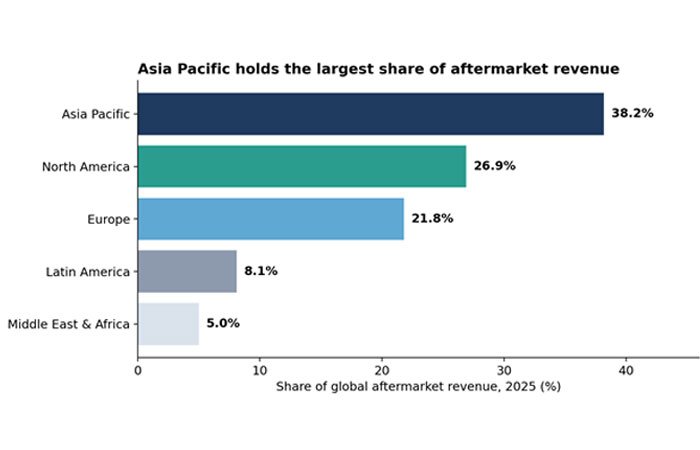
| Region | Share (2025) | Characteristics |
| Asia Pacific | 38.2% (approximately $183.2 billion) |
Increasing motorisation, existing installed base, rapid commercial vehicle growth |
| North America | 26.9% | strong do-it-yourself attitude, presence of retail chains |
| Europe | 21.8% | Strict regulation, remanufacturing, circular economy focus |
| Latin America | 8.1% | Growing logistics fleets, price-sensitive buyers |
| Middle East And Africa | 5.0% | Expanding fleets, informal retail channels |
Asia Pacific is the largest region and, on the report’s account, driven by China’s vehicle base, rising ownership in India and Southeast Asia, and logistics growth. India illustrates the potential. ACMA values its auto component industry at USD 80.2 billion in FY25, with the aftermarket at USD 11.8 billion. Its Director General has noted that globally the aftermarket is about as large as OEM supply, while in India it is under 15% of the components business, with counterfeit parts a persistent constraint.
North America has an older fleet and a strong DIY culture. The report estimates DIY at 37.2% of service demand there, against 31.8% in Europe and 28.7% globally. Large retail chains and independent repair shops dominate distribution.
Europe is shaped by regulation and sustainability. The report points to circular-economy rules, a large remanufacturing sector, and restrictions on uncertified parts in the EU and California.
Latin America and the Middle East & Africa together hold 13.1% of the total. Both are described as price-sensitive, with fast-growing commercial fleets and a large informal retail channel alongside formal parts distributors.
Which segments are growing fastest
The blended 4.8% hides a wide spread. The report’s estimates:
| Segment | Share (2025) | CAGR to 2034 |
| Services | 16.6% | 6.1% |
| Accessories | 31.1% | 5.4% |
| Replacement parts | 52.3% | 4.2% |
| Commercial vehicles | 28.6% | 5.3% |
| Passenger cars | 71.4% | 4.6% |
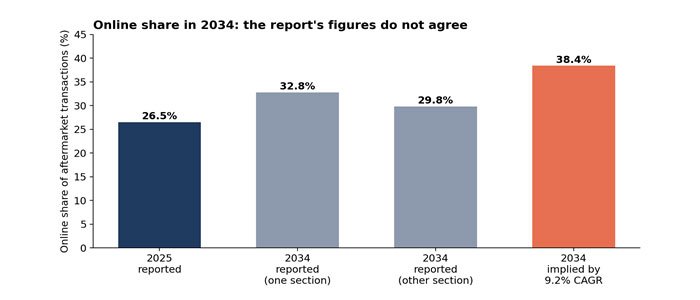
| Online channel | 26.5% | 9.2% |
| Certified parts | 38.2% | 5.3% |
| Genuine (OE) parts | 45.1% | 3.8% |
| Uncertified parts | 16.7% | -2.1% |
Services develop faster than components since nowadays’ automobiles have lots of electronics, and service requires diagnostics and qualified personnel. Commercial vehicles develop faster than passenger cars since logistics companies work continuously, and their cars cannot be down for a long period of time. Aftermarket parts that have certification approach the market share of genuine OE parts, which have 30% to 50% premium over certified ones. Uncertified parts are the only category forecast to shrink.
The service channel breakdown matters for dealers. Independent do-it-for-me shops hold 54.2% of service demand and are forecast to grow at 5.2%. OE dealership service holds 17.1% and is forecast to grow at 3.1%, the slowest of the three channels.
Reading the forecast with care
Forecast reports are useful for direction, but several figures in this one do not fully reconcile.
The report gives online’s 2034 share as 32.8% in one section and 29.8% in another. Neither matches its own growth rates. If online sales increase at a rate of 9.2% annually, and the entire aftermarket increases at an annual rate of 4.8%, online’s percentage share will be almost 38% in 2034. Directionally speaking (online increasing), it seems realistic, but not the percentages themselves.
Overall size also depends on definition. The US aftermarket alone is expected to reach US$434.9 billion in 2025, after 5.7% growth in 2024, close to the entire global figure in the report. The two sources clearly measure different scopes. Growth rates are safer to compare than dollar totals.
The EV assumption is the third to watch. The report projects EVs at about 28.4% of the global vehicle base by 2034. S&P has noted upward pressure on the average age of battery-electric vehicles as their sales growth slows. A slower ramp would keep the conventional service mix in place for longer.
Trade and regulation
Two policy areas could move these numbers.
Tariffs. A 25% Section 232 tariff extended to many imported auto parts in the US in 2025. The US Auto Care Association’s 2026 Factbook says tariff disruption could cut 5 to 6% of aftermarket revenue. The US imported $139 billion of aftermarket parts in 2023, with 47% coming from Mexico. One industry estimate puts the added cost at $20 to $50 per repair involving tariffed parts. S&P’s assessment is that the aftermarket is better placed than other sectors to absorb this, since repair demand continues regardless of price. The effect on global trade flows in parts is still developing.
Right to repair and data access. The US REPAIR Act, which would give independent shops access to vehicle repair data, has not been enacted, though a House subcommittee held a hearing on it in January 2026. In Europe, CLEPA has said in-vehicle data access needs further guidance under the European Commission’s Data Act. Australia offers an early data point. Its right-to-repair rules, in force since July 2022, were followed by a 6.7% rise in industry turnover, equal to A$2.4 billion, according to the Australian Automotive Aftermarket Association.
Dealers and OE service networks
Franchised dealers are part of the aftermarket, and US figures show why headline growth does not reach every player equally. According to NADA data, U.S. dealerships made more than $156 billion from servicing and parts sales in 2024, which was 13.2% of the overall dealership revenues.
Cox Automotive’s 2026 study points to a shift underneath. Dealership share of service visits for vehicles under two years old dropped from 68% to 55% since 2018, while independent outlets grew 12% to roughly 299,000. Once a customer uses a dealership service lane, 89% consider returning, while only 20% of those servicing elsewhere consider switching. Only 23% of new-vehicle owners have a first appointment booked for them.
One dealership in the study, The Niello Company, said its service department “was flying blind and needed to step up its game.” It responded with clearer pricing, firmer service-time estimates, and text, photo and video updates. Cox also found that customers who service at a dealership are 74% more likely to buy their next vehicle there, which links service retention to vehicle sales.
ADAS and EVs: new kinds of work
S&P’s 2026 aftermarket trends report identifies the growing number of ADAS-equipped vehicles as an opportunity, since sensor calibration and diagnostics add work that basic workshops may not be equipped to do. Electrification adds new service categories, such as battery thermal management and high-voltage systems. It also removes some traditional ones, and the report itself lists reduced engine and transmission maintenance as a threat to established segments.
What the numbers suggest
- The 4.8% CAGR rests mainly on fleet age, which changes slowly, so it is a more dependable driver than technology adoption.
- Asia Pacific holds the largest share, while North America and Europe have the oldest fleets and most mature distribution.
- Services, commercial vehicles, online sales and certified parts are forecast to grow faster than the average, and OE dealership service the slowest.
- Tariffs and data-access rules are the biggest policy swing factors.
- Overall size varies widely by source, so growth rates are the better basis for comparison.
Conclusion
There is no breakthrough needed to continue the growth of the aftermarket; it will continue to grow due to the aging of cars and their increased need for repairs. What remains in question is who profits from that growth, how fast electric vehicles transform that equation, and how the regulations will sort themselves out.
Author Bio –

Ashish Kolte is a Marketing Manager at Dataintelo with expertise in marketing, market intelligence, and business strategy. He combines marketing insights with industry research to analyze market trends, identify growth opportunities, and provide data-driven perspectives on emerging industries and global business developments.